
The name Holm Tree may not be familiar to most people. Amateur growers may instead recognize the Quercus by its nicknames of Holm Oak or Holly Oak. Holm is another name for Holly. The English use the latter moniker because this oak tree's leaves resemble those found on the Holly bush. Today, the Holm tree is embraced by a variety of cultures thanks to its ornamental value.
Appearance of the Holm Oak Tree
The average lifespan of the slow-growing Holm tree is about 400 years. While the tree's overall appearance changes slightly over time, its main characteristics don't deviate much. As with other oak tree varieties, the Holm Oak is a long-lived, strong tree.
Bark
Immature Holm trees have light green or light gray smooth bark. As the tree ages, it becomes darker and develops a furrowed texture.

Leaves
The tree's dark green leaves sport a leathery texture on the top; however, the bottom of the leaves feature a silver color and very fine hair. The leaves also have prickly edges that are very similar to those found on traditional Holly plants. As the tree matures, the edges of the leaves soften and the sharp points disappear.
Flowers
The blooms of the Holm tree are elongated yellow catkins. The catkins appear in late spring, giving the canopy a bright pop of color before the tree has fully leafed out.
Fruit
The tree's fruit is very similar to the standard acorn, measuring about three centimeters, and resides in a small cup with thin scales. The acorns are green when they are young, but turn reddish-brown as they mature and drop in autumn.
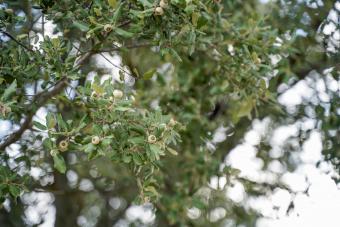
The Holm is also known for its picturesque rounded canopy and low-hanging branches. Its size and shape allow it to be a timeless architectural presence in urban and suburban settings.
Holm Tree Types
The Holm tree is part of the Quercus genus. Its botanical name is Quercus ilex and features two types:
- Querus ilex: This species features narrow leaves and bitter tasting acorns. The tree is commonly found growing near coastlines in temperate climates such as France and Greece.
- Quercus ilex rotundifolia: The leaves of this type of Holm are broader and its acorns are sweet tasting. It tends to grow in warmer climates, including North Africa and Portugal.
Both types of Holm trees are hardy species that feature large spreading leaf canopies and thick trunks.
Where the Holm Grows
The Holm tree has its roots in the Mediterranean region, though it can also be found thriving in:
- Spain
- Turkey
- Croatia
- France
- Northern Africa
- England
- Slovenia
- Portugal
- Ireland
- North America
The evergreen tree prefers sandy and clay soils and has the unique ability to grow in full shade. It can also withstand salt air and other maritime conditions. However, while it can tolerate high winds and salty air, the Holm tree is defenseless against extreme cold and cannot survive in regions that experience freezing temperatures.
Popular Uses
The durable tree is prized for its very hard and heavy wood, which can be crafted into the following:
- Pillars
- Wagons
- Boats
- Tool handles
- Furniture
- Caskets
- Bars
The Holm tree is also used as firewood, and burned timber is collected to make charcoal.
The other main component of the Holm tree is its fruit. The tree's acorns are edible and are often boiled and used as a medicine to treat infections. Additionally, the tree's seeds can be dried, ground into a powder and used as a thickener in soups, stews and bread dough.

Interesting Facts About Holm Oak
Given its ability to tolerate shade and air pollution, the Holm tree is a top pick for public parks, gardens and city streets.
In addition, pig farmers also treasure the Holm tree for its acorns. Iberian swine are particularly fond of the Holm's fruit and regularly devour it as a part of their daily meals. Slaughtered Iberian pigs which dine on the Holm's fruit are often referred to as "Jamon de Bellota" which means "acorn ham" or Serrano ham.
Other interesting facts about the Holm tree include:

- The seeds are roasted and used as a substitute for coffee.
- Oil from the tree is edible and often added to pork dishes.
- The tree is often found flourishing near sacred tombs in Palestine due to the belief that it wards off evil spirits.
Holm Oak Care
Holm trees add ornamental value to a variety of landscapes, but they prosper on seaside properties.

If you are planning to add a Holm tree to your yard, consider the following growing tips:
- While the tree is tolerant of clay and sandy soils, it still needs moisture to grow. Be sure to water the Holm regularly during its first few growing seasons.
- Pruning is recommended if you do not want the Holm to grow beyond a manageable height. Also, because the tree is rather dense, it should be thinned regularly to increase air circulation and make it look airy and graceful.
- Mulch is not necessary for the mature Holm tree to prosper, provided it was planted in fertile soil as a sapling.
- If you don't plan to prune the tree regularly, do not plant it under power lines, as the Holm's branches can get caught in the wires.
Holm Diseases
Given its exceptional hardiness, the Holm is not susceptible to many diseases. Some of the very few that attack the tree are the following:
- Root Rot: The Holm tree can contract this disease if its root system is made to stand in water for a long period of time. Symptoms include fungus growing on the tree's roots, which can spread to the tree's bark and branches.
- Wilt: This serious disease affects the tree's leaves. The Holm's foliage can be stunted and turn yellow when infected. Other symptoms include leaf curling, drying, and premature drop.
Holm Oak Trees Add Value
The Holm Oak brings several aesthetic values to your overall landscape design. Its resilience in different environments makes it a valuable and versatile tree choice.


